
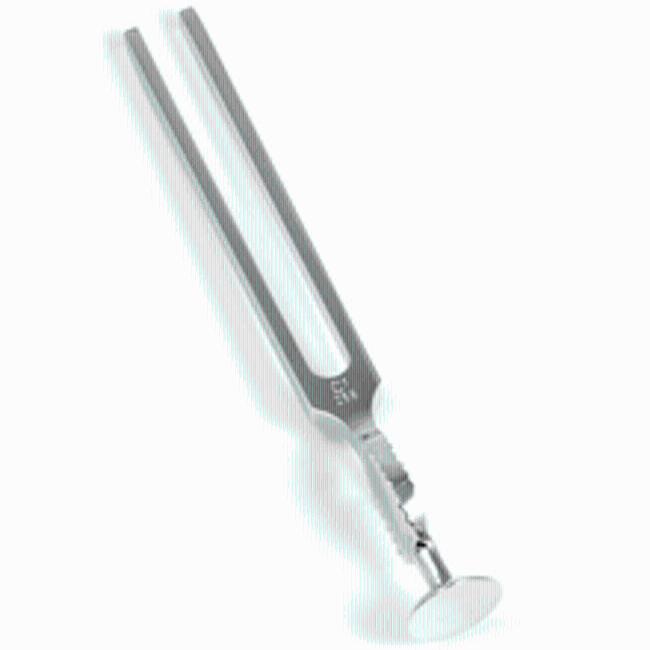
A tuning fork is produced by attaching a U-shaped metal bar to a straight piece, termed the stem. The commonly used medical tuning fork has a disc-like portion of the stem for the examiner to grip between the fingers, and an expansion, the foot piece which provides a suitable surface for the transmission of sound to the skull. It also helps in the application of the fork to the skull. The limbs of the fork (tines) are termed prongs.
The point where the prongs join the base is known as shoulder. The sides of the prongs which face one another are termed ‘inner normal faces’ and other sides which are parallel to these are termed ‘outer parallel faces’. When a force is applied to an outer normal face and right angles to it the prongs are set in transverse vibration and they alternately approach and separate from each other. The two nodal points which are situated in shoulders remain…