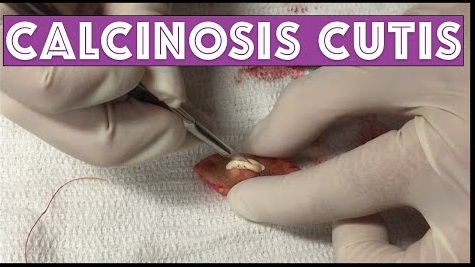
In all cases of calcinosis cutis, insoluble compounds of calcium are deposited within the skin due to local and/or systemic factors. These calcium salts consist primarily of hydroxyapatite crystals or amorphous calcium phosphate. The pathogenesis of calcinosis cutis is not completely understood and a variety of factors allow for different clinical scenarios to occur. Metabolic and physical factors are pivotal in the development of most cases of calcinosis.
Ectopic calcification can occur in the setting of hypercalcemia and/or hyperphosphatemia when the calcium-phosphate product exceeds 70 mg2/dL2, without preceding tissue damage. These elevated extracellular levels may result in increased intracellular levels, calcium phosphate nucleation, and crystalline precipitation. Alternatively, damaged tissue may allow an influx of calcium ions leading to an elevated intracellular calcium level…