
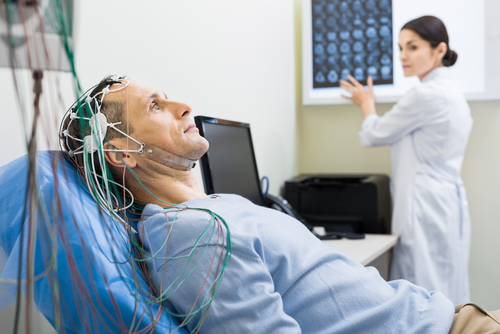
Electroencephalography (EEG) is a surface recording of cortical neuronal activity and is made up of frequencies up to around 40 Hz, often described as Delta <4Hz, theta 4-7 Hz, alpha 8-13 Hz and beta 13 to 40Hz. Alpha activity occurs during relaxation with eye closed. Mental activity or eye-opening Results in higher frequency, lower amplitude waveform. The normal EEG amplitude is 10-50 microvolts.
Anaesthetics affect the EEG, as do other factors such as blood pressure, Po2, Pco2, temperature and stimulation. The raw EEG signal can be analyzed with respect to time or frequency Frequency can be analyzed by Fourier transform yields frequency spectrum the frequency within each frequency band. It is quantified by indices such as the median power frequency and spectral edge frequency. These have been studied during single drug anaesthesia and correlate well with drug level and clinical…