
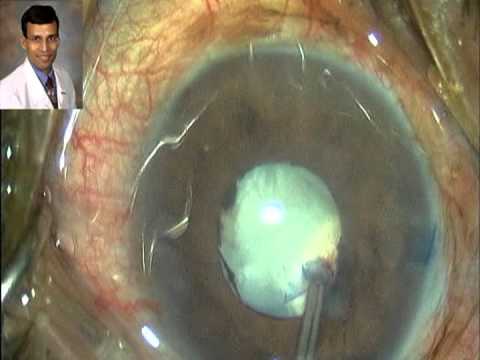
Traumatic cataracts occur secondary to blunt or penetrating ocular trauma. Infrared energy (glass-blower's cataract), electric shock, and ionizing radiation are other rare causes of traumatic cataracts. Cataracts caused by blunt trauma classically form stellate- or rosette-shaped posterior axial opacities that may be stable or progressive, whereas penetrating trauma with disruption of the lens capsule forms cortical changes that may remain focal if small or may progress rapidly to total cortical opacification.
Lens dislocation and subluxation are commonly found in conjunction with traumatic cataract. Other associated complications include phacolytic, phacomorphic, pupillary block, and angle-recession glaucoma; phacoanaphylactic uveitis; retinal detachment; choroidal rupture; hyphema; retrobulbar hemorrhage; traumatic optic neuropathy; and globe rupture. In this video, a 30 years old…