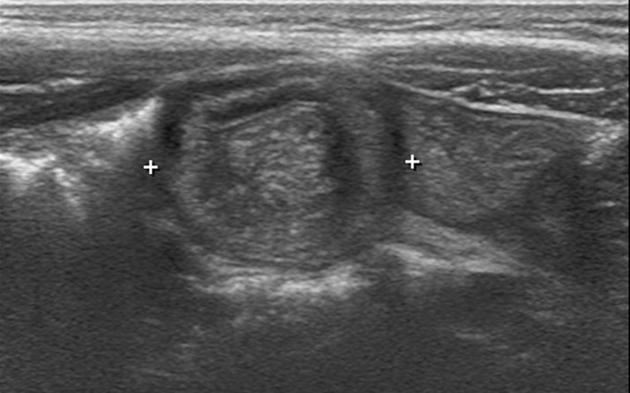
Ultrasound with its lack of ionizing radiation should be the investigation of choice in young patients, and is effective in competent hands in identifying abnormal appendixes, especially in thin patients. However, the identification of a normal appendix is more problematic, and in many instances, appendicitis cannot be ruled out.
The technique used is known as graded compression, and uses the linear probe over the site of maximal thickness, with gradual increasing pressure exerted to displace normal overlying bowel gas. Findings supportive of the diagnosis of appendicitis include: A peristaltic, noncompressible, dilated appendix ( >6 mm outer diameter) Appendicolith Distinct appendiceal wall layers Echogenic prominent pericaecal fat Periappendiceal fluid collection Target appearance (axial section) Confirming that the structure visualised is the appendix is clearly essential and…