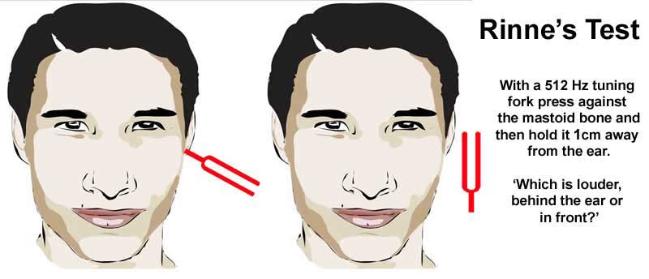
This is the best-known test of the tuning-fork tests used to distinguish conductive from sensorineural hearing loss. In the Rinne's Test, the patient’s ability to hear by bone conduction is compared with that by air conduction. The clinician can simply ask ‘which is louder, number one sound’ (holding the vibrating fork with prongs near the ear)’ or ‘number two sound?’ (transferring the same vibrating tuning-fork to press the footpiece gently but firmly on the corresponding mastoid process) A normally hearing subject will say ‘Number one sound’; or so will a subject with a sensorineural hearing loss, unless the loss is marked.
A subject with an incipient conductive loss or with a conductive component up to 20 dB in a mixed loss will also give the same response. The response in which a sound is heard better by air conduction than by bone conduction is referred to as a Rinne Positive…