
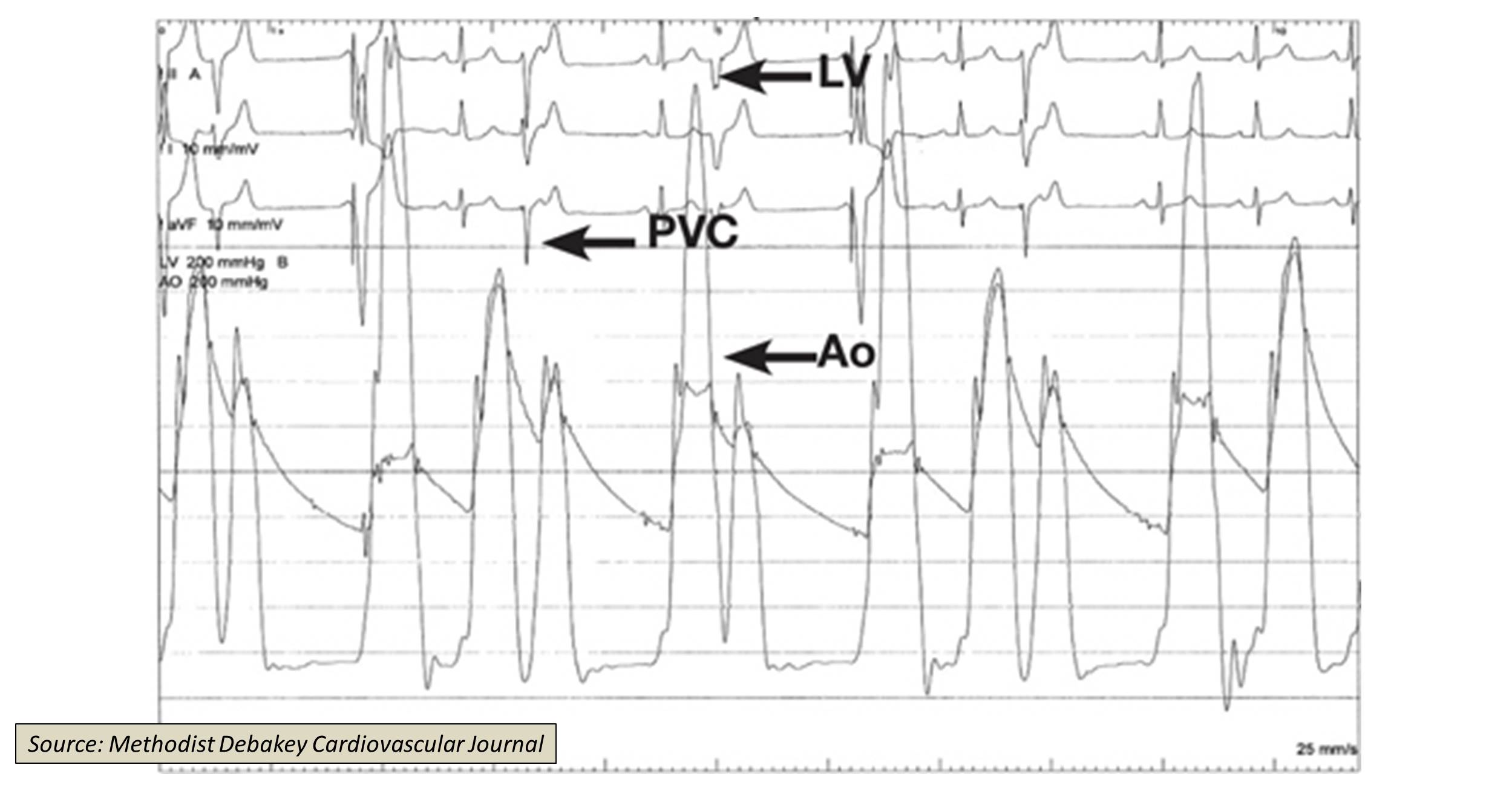
Brockenbrough-Braunwald-Morrow sign is a useful catheterization laboratory maneuver that indicates the existence and degree of left ventricular outflow tract (LVOT) obstruction, prior to, during, and after alcohol septal ablation (ASA). It was first described by Brockenbrough et al. in 1961. The Brockenbrough-Braunwald-Morrow sign is characterized by a paradoxical decrease in the arterial pulse pressure and an associated increase in the left ventricular systolic pressure in the beat following a premature ventricular contraction (PVC).
It presents with the characteristic “spike and dome” waveform pattern on the left ventricular and aortic pressure gradient (Cover image). In which of the following conditions is the Brockenbrough-Braunwald-Morrow sign usually observed? Aortic stenosis Hypertrophic cardiomyopathy Pulmonary stenosis Mitral stenosis (Answer is posted in the comment section…