
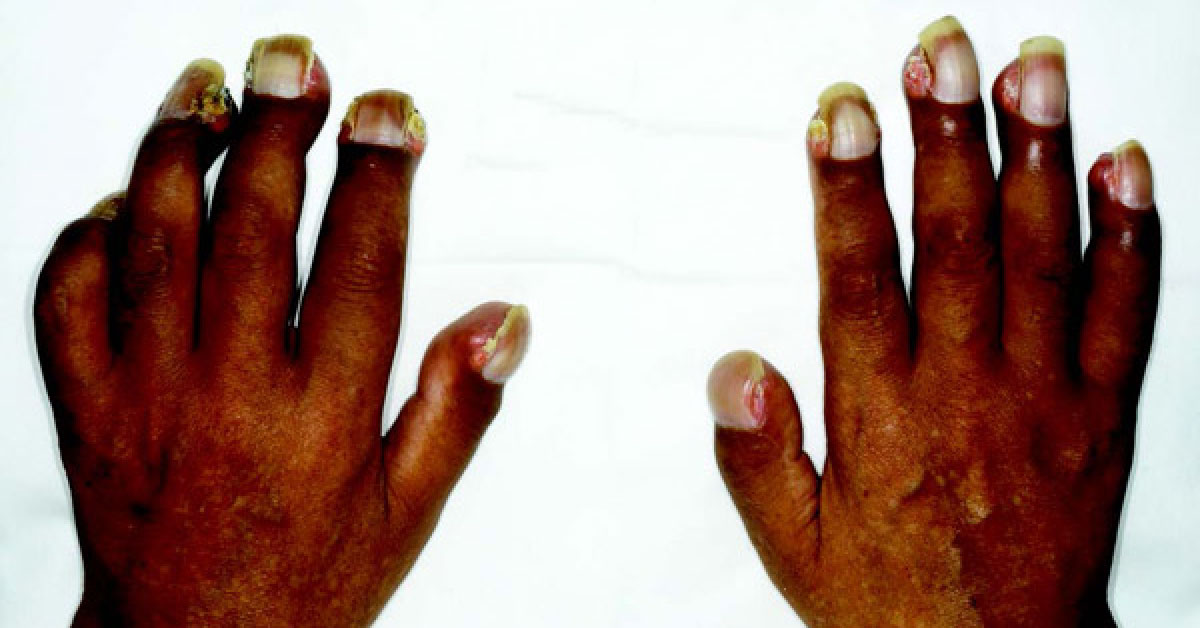
A 51-year-old man who had been receiving haemodialysis for 15 years was referred to the hospital with progressive calcified nodules on his fingers. He had been undergoing haemodialysis three times per week, for a total of 12 h per week. The patient had been deemed to have end-stage renal disease of unknown cause.
He had undergone a parathyroidectomy 2 years before the referral because he was believed to have progressive extraskeletal calcification caused by hyperparathyroidism with constant hypercalcaemia that was refractory to medical treatment; laboratory findings were compatible with secondary hyperparathyroidism. Since the parathyroidectomy, laboratory findings had returned to normal, but the nodules had progressed and made him unable to grip. A family history could not be obtained because the patient was an orphan, but through a careful interview, the clinician identified a past…