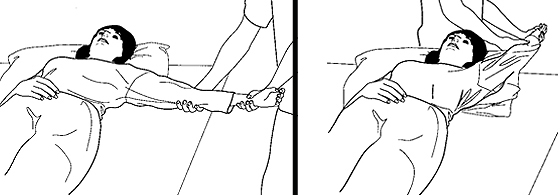
Relaxed passive movements may give the following information: That the muscles are flail and are allowing movement to occur with no opposition and may even be allowing an excessive range of movement to occur. If many muscles are involved the limb may feel heavy as there is no support from normal muscle activity. That the muscles are showing excessive opposition to stretch. If they are showing spasticity they may show the clasp-knife phenomenon and will certainly oppose movements away from the spastic patterns.
If they are showing rigidity all movements will feel stiff and the cog-wheel phenomenon may be detected. Passive movements should be performed both slowly and quickly to detect any difference in the response of muscles to slow and quick stretch. If the muscles are found to be flail they may be hypotonic or atonic. However, quick passive movements to joints controlled by the…