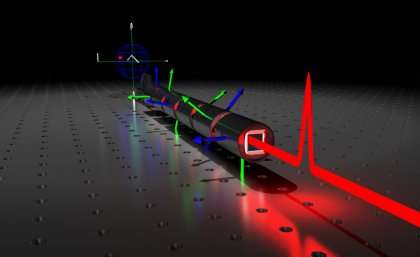
A team of researchers, including The University of Queensland's Dr Joel Carpenter, has developed echo-less lights that could improve medical imaging inside the body, leading to less-intrusive surgery. First proposed in 1948, but never before tested, the new light states may lead to the development of 'super-thin' endoscopes that can reach into what were before inaccessible regions, such as inside the brain. The team, from the Centre for Ultrahigh Bandwidth Devices for Optical Systems (CUDOS), created techniques to take images deep inside skin tissue.
The method allows waves of light, sound or radio to travel through complex obstacles, which would usually scatter the wave, yet have the entire wave arrive at once at its point of destination, echo-free. Dr Carpenter, who designed and performed the experiments, likened the waves of light to yelling a message to a friend at the end of a…