
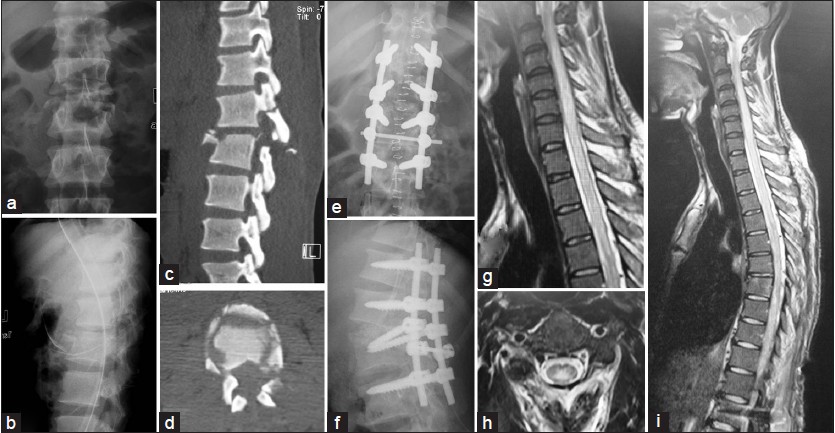
A 35-year-old male presented with paraplegia American Spinal Injury Association (ASIA A) following a motor vehicle accident. Spinal X-ray and computed tomography (CT) revealed L1-L2 fracture-dislocation with no other vertebral injury. Neurologic examination revealed paraplegia below level L1 with bladder and bowel involvement (ASIA A). The patient underwent posterolateral decompression, interbody fusion using local graft with posterior instrumented fusion from D12-L3. The cord was adequately decompressed without any adverse events.
On postoperative day-5, a patient developed weakness of both the upper limbs (2/5) with sensory loss below C6 dermatome. Magnetic resonance imaging (MRI) of the whole spine showed bright cord signal in T2 and short tau inversion recovery (STIR) sequence extending up to C2-C3 cervical segments.(image attached). What inference can be drawn from this case? *This…