
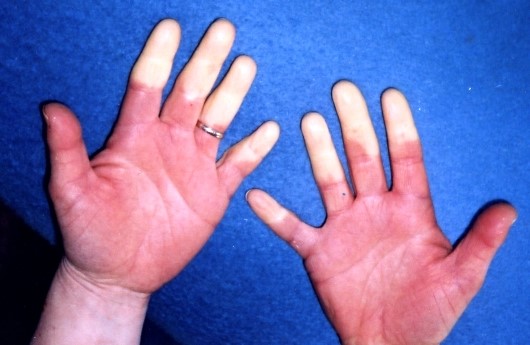
It results from severe vasospasm in response to temperature change; causes marked and typically sharp demarcated pallor of one or more digits. As circulation reduces, the digit becomes blue (cyanotic) and then bright red because of rebound hyperemia — the triphasic response. Raynaud's is more common in females than males.In young women, the condition is often a harmless nuisance requiring warm gloves and sometimes vasodilators. Its onset for the first time in older people warrants investigation.
Raynaud's may also be part of a systemic autoimmune disorder (rheumatoid arthritis, systemic lupus erythematosus, or systemic sclerosis) and it occasionally leads to necrosis. When associated with rheumatoid disease, Raynaud's can be extremely severe and requires specialist referral. It can also occur in people who use vibrating tools. Roughly two out of three patients with primary Raynaud's…