
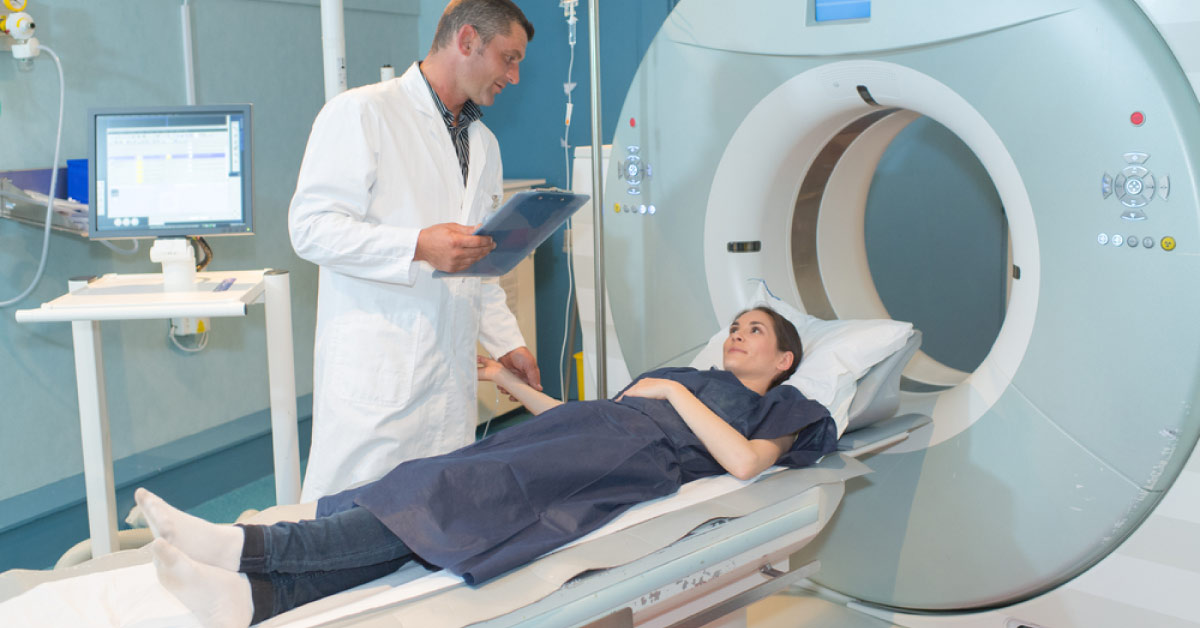
Magnetic Resonance Imaging (MRI) is a test that has been useful for decades in diagnosing problems of the brain, spine, joints, and other stationary organs. In recent years, thanks to newer techniques, MRI is also proving very useful in evaluating the organs that move — including the heart and major blood vessels. MRI is an imaging technique that takes advantage of the fact that the nucleus of certain kinds of atoms (most typically, the single proton that forms the nucleus of a hydrogen atom) will to vibrate, or "resonate," when exposed to bursts of magnetic energy.
When the hydrogen nuclei resonate in response to changes in a magnetic field, they emit radio frequency energy. The MRI machine detects this emitted energy, and converts it to an image, so that various body structures can be viewed in astonishing detail. Hydrogen nuclei are used because hydrogen atoms are present in water…